
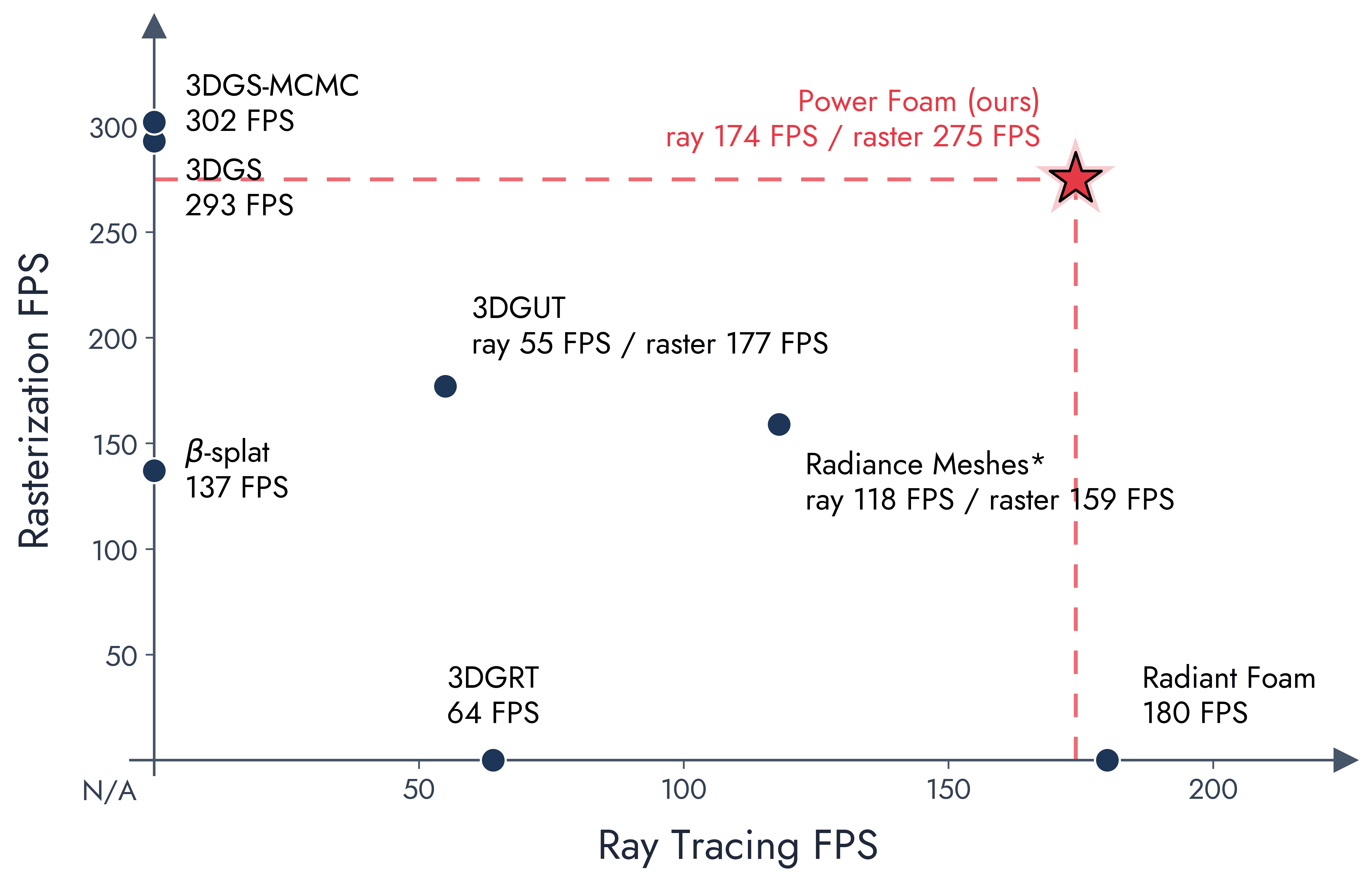
When Radiant Foam arrived last year, one of its most compelling qualities was also its most conspicuous limitation. The method excelled at ray tracing, delivering hundreds of frames per second on consumer hardware without any dedicated ray tracing hardware, but it couldn’t rasterize. Voronoi cells, the foam’s building blocks, are potentially unbounded by definition, and tile based rasterizers, the engine behind 3DGS‘s speed, need bounded geometry to work.
Power Foam, a new paper from the same theialab group at Simon Fraser University and UBC along with collaborators at Google DeepMind and Google, swap standard Voronoi cells for power diagrams. It’s a generalization where each cell carries an associated radius that controls its spatial extent. Bounded cells can be rasterized. They can also still be ray traced. A single trained model now works with both pipelines, switching between them on demand.
The representation also introduces an oriented surface formulation that explicitly decouples geometry from appearance, embedding texture directly onto the interfaces between cell interiors and exteriors. For view dependent color, the method replaces spherical harmonics, the standard in 3DGS, with a spherical Voronoi decomposition across the sphere of directions. Unlike harmonics, which are a fixed bandwidth frequency basis, spherical Voronoi adaptively partitions the directional sphere, allowing the representation to capture sharper, more complex angular variation without the bandwidth ceiling that makes specular effects and fine reflections difficult to represent cleanly in standard Gaussian Splatting.
Power Foam offers instead is a representation that’s genuinely competitive in both rasterization and ray tracing simultaneously. Fisheye rendering, reflections, and refractions have been enabled by ray tracing. Power Foam makes these available as a switchable mode on the same model rather than requiring a separate trained system. The project page includes real time demos of reflections off a chrome sphere and refractions through glass that are worth a look.
It will be interesting to see how Power Foam develops and whether the approach opens the door to dynamic or generative applications, areas where Radiant Foam’s ray tracing pedigree would have real value if paired with rasterization’s speed.
The code for Power Foam is already available with an Apache 2.0 license, and the full paper with interactive comparisons is available here.


