When we first hosted Deploying Radiance Fields Across Real-Time and Web as a Birds of a Feather session at SIGGRAPH 2025, the goal was to put researchers and practitioners in the same room and let the conversation unfold naturally. Radiance fields may be young as a formal research area, but their transition into real products is already well underway.
That experiment returned, this time at SIGGRAPH Asia 2025 in Hong Kong.
Co-organized once again by Michael Rubloff of Radiancefields.com and Lukasz Mirocha of Opus Lab, the second edition of the BoF expanded in scope. With the support of Arrival.Space as a dedicated SIGGRAPH Asia hub, the session brought together six speakers working across research, tooling, deployment, and even physical world outputs of radiance field representations.
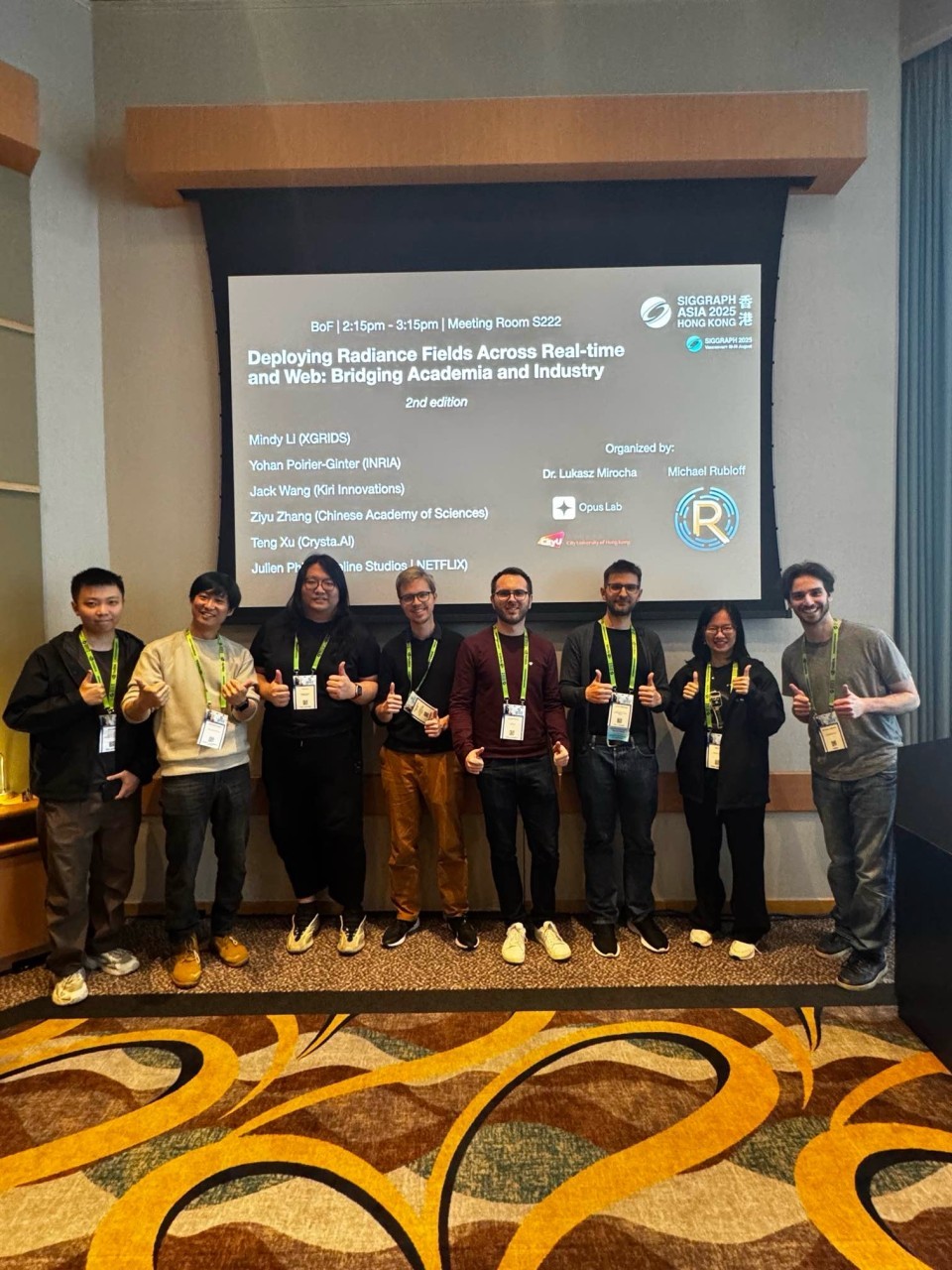
The SIGGRAPH Asia lineup reflected just how broad the 3D Gaussian Splatting ecosystem has become.
Mindy Li opened with XGRIDS’ work on multi-SLAM pipelines and productized 3DGS solutions for digital twins and simulation.
From there, Yohan Poirier-Ginter explored editable, physically based reflections in ray traced Gaussian radiance fields, showing how splats are increasingly intersecting with classical rendering concerns like material response and lighting fidelity.
On the application side, KIRI Engine, presented by CEO Jack Wang, demonstrated how consumer friendly scanning tools are rapidly lowering the barrier to high quality 3DGS capture, while their Remy app available in China has already crossed two million users.
Ziyu Zhang presented Fast 3D Gaussian Splatting, who medaled in the Volumetric Video Workshop at the conference.
Extending radiance fields beyond the screen, Teng Xu of Crysta.AI explored volumetric 3D printing for both NeRFs and 3DGS, offering a glimpse of how these representations may increasingly manifest in physical form. Crysta won Best in Show back in August at SIGGRAPH in Vancouver.
Closing the session, Julien Philip presented DEGS, Detail Enhanced Gaussian Splatting, developed at Eyeline Studios for large scale volumetric capture. The work underscored a recurring theme at SIGGRAPH Asia that dynamic splats are about to seriously take the main stage.
What stood out most wasn’t any single technique or demo, but the connective tissue between them. Researchers were fielding questions from people shipping products today. Tool builders were stress-testing ideas born in academia. And across every talk ran the same undercurrent: radiance fields are no longer speculative—they are being deployed, scaled, and refined in the wild.
This was the same energy we felt at SIGGRAPH 2025, now amplified by a broader, more international community. The dialogue is global and it’s accelerating. As we look ahead to SIGGRAPH 2026 in Los Angeles, our intention remains the same. Keep creating space where research meets real world applications, and where the people shaping lifelike 3D can learn directly from one another.
If you’re working on radiance fields, whether in a lab, a startup, or a production pipeline, we’d love to connect. More BoFs are coming, and this conversation is only just beginning.


