

When SpAItial emerged earlier this year with a $13 million seed round, the company spoke in ambitious but necessarily abstract terms. Its founders described Spatial Foundation Models, AI systems designed not merely to interpret images, but to reason about space itself. At the time, much of that vision was implied rather than demonstrated. Now, at the very end of the year, we are seeing results.
The company has now unveiled Echo, its first public model for 3D world generation, and with it, a clear signal of where generative spatial AI is headed. Echo takes a single image or a short text prompt and produces a fully navigable, 3D consistent environment that can be explored in real time. Camera movement is unconstrained, novel views are rendered instantly, and the resulting scenes maintain global spatial coherence rather than collapsing into disconnected image fragments.
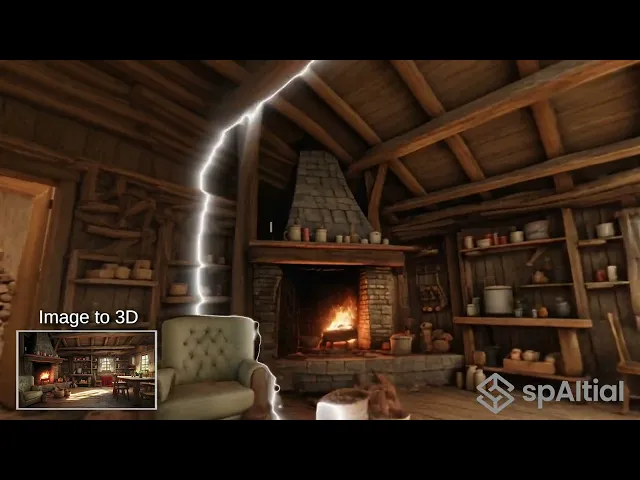
Rather than treating 3D as a byproduct of multi-view image synthesis, Echo explicitly infers a unified, metric scale scene representation that encodes both geometry and appearance. Every rendered frame, including depth, is derived from the same underlying spatial model. This choice places Echo squarely in the lineage of radiance field driven systems.
For its public web demonstrations, SpAItial renders these internal scene representations using Gaussian Splatting, enabling interactive performance directly in the browser, even on modest hardware. While Gaussian splats are framed as a rendering primitive rather than the model’s core representation, their inclusion is telling. Fast, GPU efficient radiance field rendering is what allows Echo’s worlds to be explored freely, reinforcing the idea that modern generative models are increasingly judged not by single images, but by how convincingly they hold up under motion.
Beyond initial scene generation, the system supports restyling entire environments through natural language prompts, semantic decomposition of scenes into editable components, and object level editing such as removal, replacement, or insertion. These capabilities move Echo beyond passive world generation and into the realm of spatial authoring. A single photograph of a space can become a navigable, editable 3D environment rather than a static reference.
Looking ahead, SpAItial positions Echo as a foundation rather than a finished product. The roadmap points toward models that incorporate physical reasoning and dynamics, enabling environments that not only look consistent but behave consistently. That trajectory echoes a broader shift across the field: from reconstructing appearance toward modeling worlds that can be simulated, modified, and reasoned about over time.
In other news, Jan Held, announced that he has joined the company. Held has been on an exciting tear of radiance field papers, including Triangle Splatting, Convex Splatting, and most recently MeshSplatting.
Learn more about Echo from SpAItial’s website and sign up for their waitlist.