
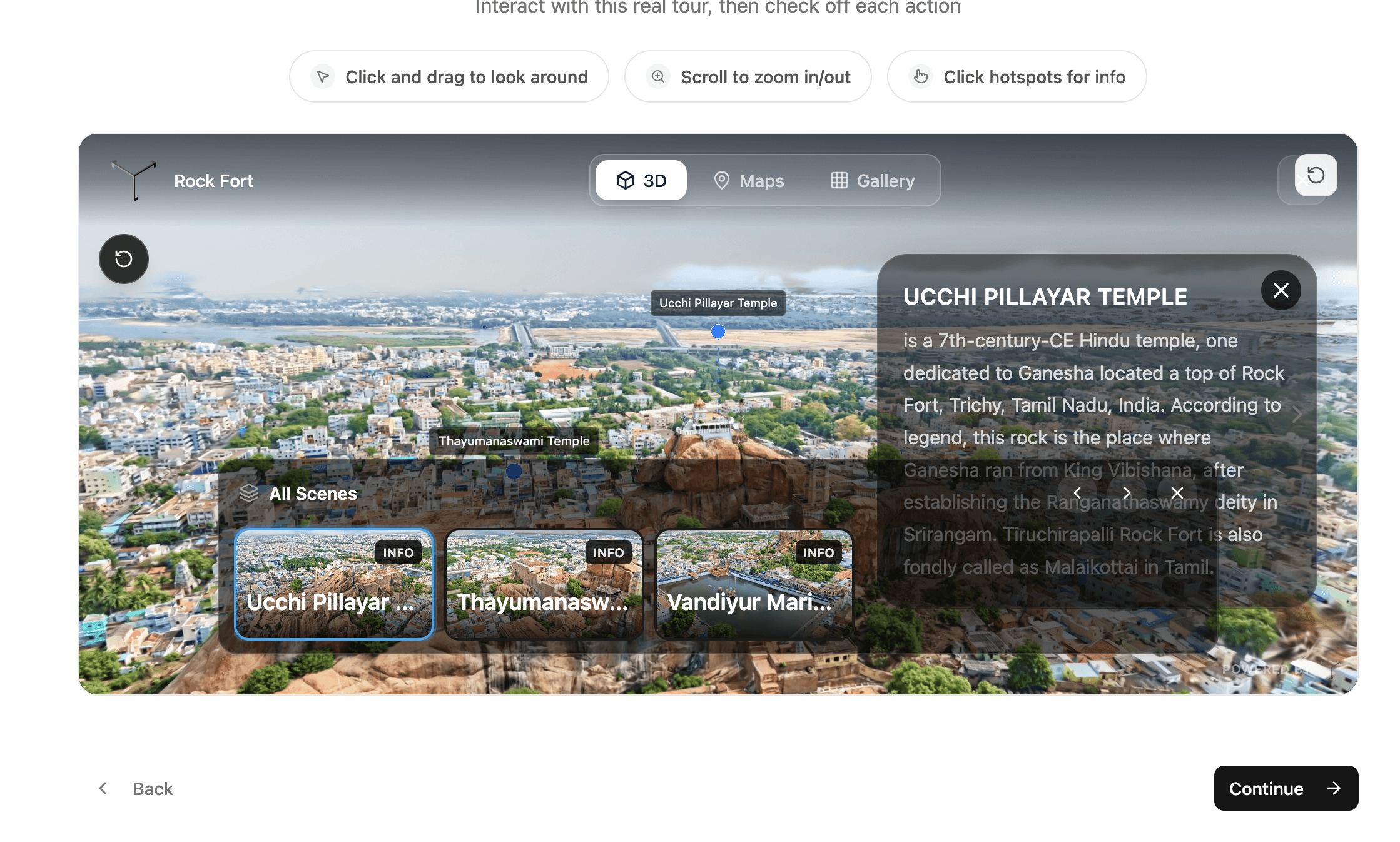
A major selling point of gaussian splatting it reconstructs lifelike 3D that renders at well above real time rates. What has become increasingly clear is that there is much more that can be done. This is the space Spatial Studio, the new platform from Real Horizons, is attempting to explore.
Spatial Studio is framed as a publishing environment for spatial content. The underlying assumption is that most business facing uses of gaussian splats require more than free navigation through a scene. They require narrative structure, intentional framing, and a way to connect spatial experience to outcomes.
The platform’s internal philosophy is summarized simply as “context is king.” Gaussian splats are treated as one component in a broader storytelling stack. Creators can upload existing splats or reconstruct them through the platform’s cloud pipeline. The web based editor abstracts much of the technical complexity that typically accompanies 3D workflows, allowing authors to focus on how a space is presented rather than how it is rendered.
The platform is built to combine 3DGS with 360 degree panoramas and large scale geographic context via Google Maps 3D Tiles. A viewer might begin with a view of a neighborhood, transition into a splat based reconstruction of a building, and then step into a high resolution panorama to examine a specific interior vantage point, or another splat. Rather than competing representations, these formats are treated as complementary.
Spatial Studio allows creators to define a guided path through space. The experience still allows exploration, but it is framed, much like a director’s cut rather than raw footage.
Tours are meant to live where audiences already are with embeds directly into client websites and instrumented with analytics. Creators can see how users move through a space, what they focus on, and how they interact with embedded calls to action.
Looking ahead, Real Horizons is positioning the platform for more demanding use cases in real estate, architecture, and large scale environments. Full level of detail support is planned to enable massive scenes and multi splat projects. On the AI front, the roadmap points toward context aware voice guidance that responds to what the viewer is actually seeing, along with semantic understanding that can automatically segment and label spatial regions.
For architectural visualization, upcoming tools such as interactive floorplans, unit stacks, and inventory management suggest a move toward end to end spatial sales experiences. Native WebXR support for devices like Apple Vision Pro and Meta Quest is also on the horizon.
By combining splats, panoramas, and maps into a cohesive narrative layer, Spatial Studio treats spatial media as something to be authored, published, and measured. For businesses in real estate, tourism, inspection, and beyond, I believe it is likely that expectations move beyond pure visualization and into education.
Learn more about Spatial Studio from their website.


