
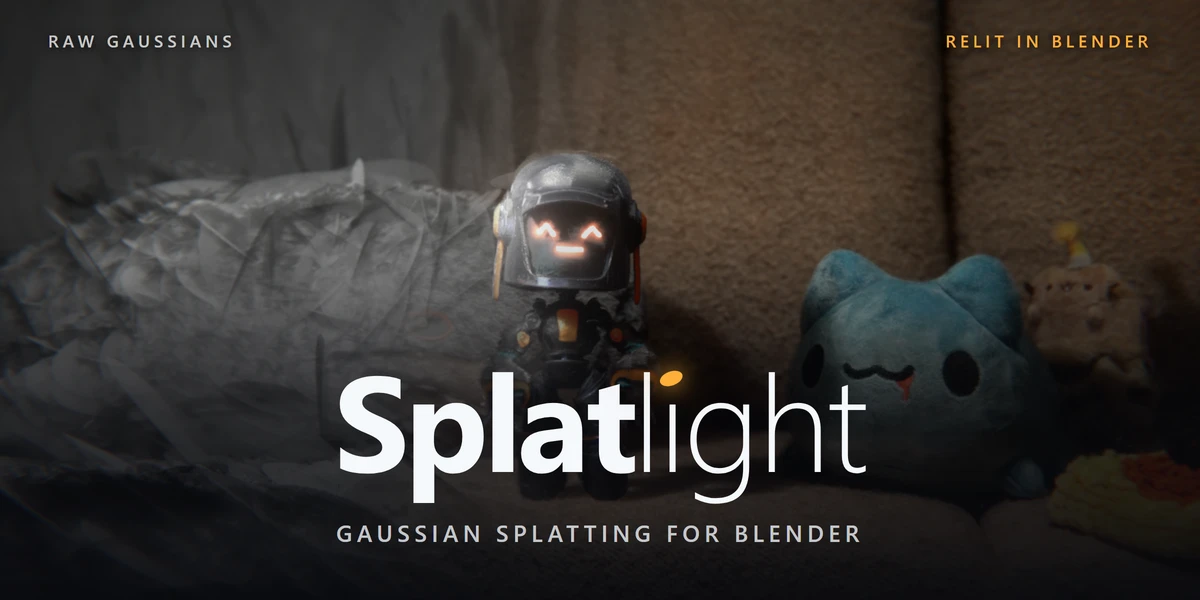
Javier Herrera has added a scene generator to Splatlight, which turns Blender geometry into a gaussian splat without a COLMAP solve.
Splatlight's generators until now trained from a moving camera video, from a single image, or from a World Labs Marble prompt, each of which begins with material from outside Blender. The new path renders the scene that is already open, and because Blender already knows where it placed every camera, those poses are passed to the splat trainer directly and no camera position solve runs.
Two rigs build the camera set. The object rig places a sphere of cameras around a selected object or collection, with a control for how near or far the cameras sit. The scene rig works from a cage, capturing every mesh inside it and computing the open space so that no camera lands clipping into geometry. The rig then distributes standpoints through that free volume, each standpoint carrying six cameras pointed at different angles. Cameras a user adds by hand are taken into account as long as they sit in the rig collection.
Render quality follows the scene's own render settings, so the ceiling is whatever the file is already configured to produce. Herrera reports that the Urban Samurai demo took about two hours end to end from rendering through processing, and an interior scene took about three, both at maximum settings on a 4080. The interior is the Blender 4.1 splash screen by Lynxsdesign.
The generators ship inside Splatlight Pro at $35, with a free LITE tier that imports, relights and exports .ply. Splatlight supports Blender 4.2 through 5.2 under the GPL and renders in EEVEE and Cycles. Neither storefront listing describes the generators beyond naming them, and no splat count ceiling or GPU floor is published for the rigs.


