
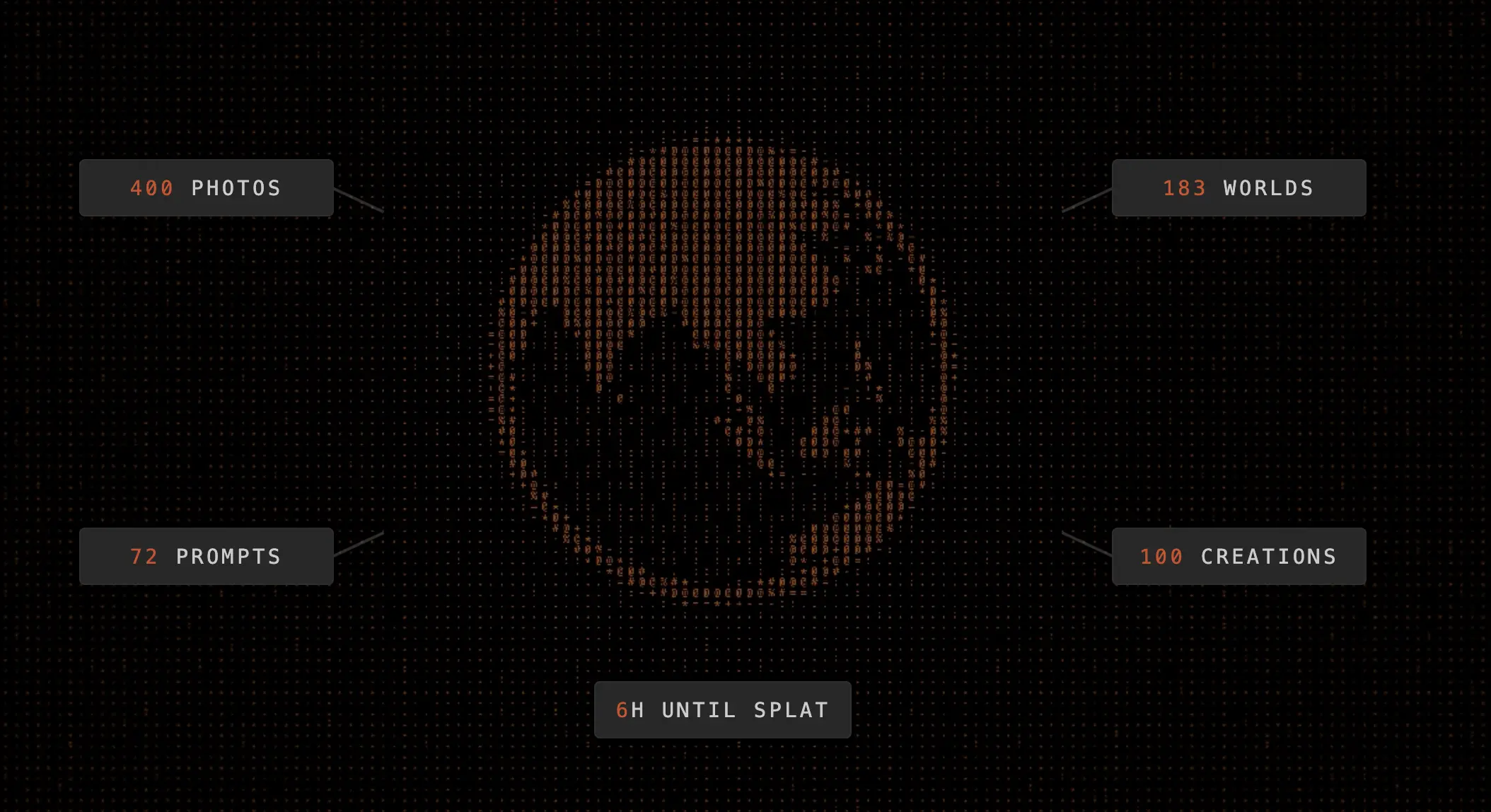
A new platform called Splatworld is facilitating an easier way to create worlds composed of gaussian splatting. Splatworld positions itself less as a single product and more as a small ecosystem built around Gaussian splats.
The most hands on entry point is the Splatworld code extension. Designed to run directly inside developer’s workflows, it allows users to generate Gaussian splats interactively rather than as a detached batch process. The extension emphasizes creative iteration, making it possible to move from a prompt or reference image to a 3D splat in a tight feedback loop, while gradually learning a user’s aesthetic preferences around lighting, composition, and mood. It draws on external generative systems such as Nano Banana for panoramic image creation and World Lab’s Marble API for converting those images into 3D Gaussian splats. The intent is to give users a relatively fast, iterative loop.
That same tooling connects to the Splatworld Agent, which represents the project’s more experimental side. The agent maintains a persistent “taste profile,” learning preferences around lighting, composition, density, and overall mood as it generates new content. On splatworld.io, a version of this agent runs continuously, autonomously creating new splat-based worlds and refining its own aesthetic judgments. Prompting, decision making, and reflection are handled through large language models such as Claude, which the system uses to reason about what to generate next and why.
For users who want to operate at scale, Splatworld also provides an open source Python toolkit for bulk generation of Gaussian splat datasets. The framework formalizes the pipeline from prompt generation, to image synthesis, to splat conversion, with optional auto labeling and export. Depending on configuration, outputs can be targeted at creative workflows, game prototyping, or robotics research, with exports into tools like Isaac Sim, MuJoCo, or Gazebo. Recently we have seen an explosion of gaussian splatting applications within the robotic and simulation field, with Ligthwheel demonstrating how they are using World Labs to aid simulation.
The final layer is the community facing side of the platform. The Explore section on splatworld.io acts as a shared space where autonomously generated splats and eventually user generated ones can be browsed and compared. It provides visibility into what the agent is producing, while also setting expectations about the kinds of environments and visual quality the pipeline currently supports.
Splatworld is best understood as lowering the friction around generating, iterating on, and sharing Gaussian splat worlds. It is MIT Licensed and can be accessed both on their website and through GitHub.


