
Company Overview
Rotor Studios is an Australian based creative studio with a long track record in high end automotive visual effects. Their team supports global vehicle brands with photoreal CG content across commercial, interactive, and immersive media. Known for innovation and efficiency, Rotor is continuously evaluating emerging technology to keep their production pipeline lean, flexible, and visually stunning.
The Challenge
In the automotive VFX space, traditional CG pipelines often involve lengthy asset creation cycles, heavy post processing, and large crews. High-fidelity photogrammetry workflows can require days of setup and refinement. NeRF based techniques, while visually promising, previously fell short in delivering the speed and resolution required for commercial automotive outputs. Rotor needed a way to reduce the cost and complexity of shoots, particularly when working with unreleased vehicles under strict confidentiality.
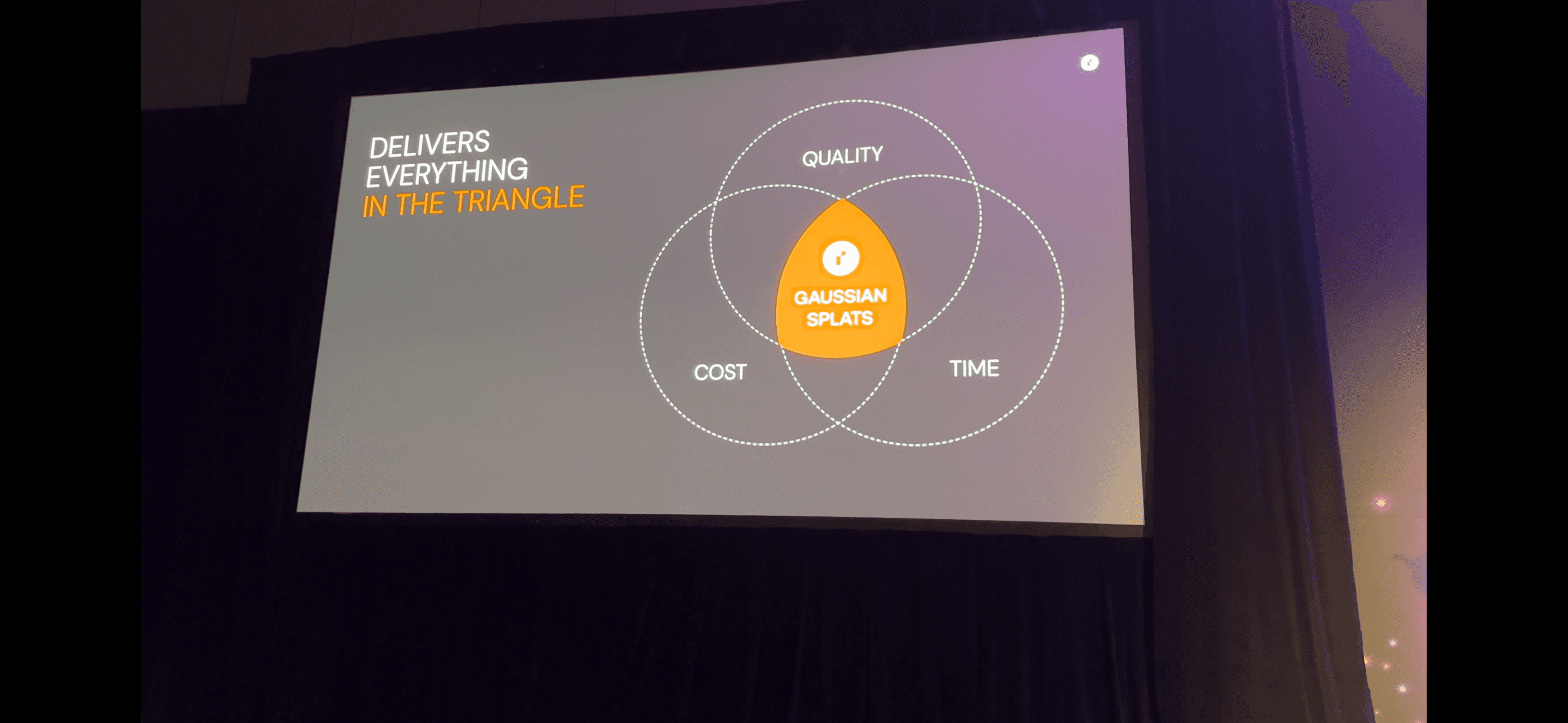
Rotor Studios, a creative studio with deep automotive expertise, is actively exploring how Gaussian Splatting can deliver quality, speed, and cost all at the same time. I recently had the chance to sit down with several members of Rotor’s technical leadership to talk about how they’re using splatting to push automotive VFX into new territory.
The team first became interested in Gaussian Splatting shortly after its introduction in research circles. Like many early adopters, they had previously experimented with NeRFs but ran into the limitations of slow rendering speeds at the time and insufficient fidelity for high end commercial work. Gaussian Splatting immediately caught their attention due to its much faster real time rendering capabilities while retaining lifelike detail.
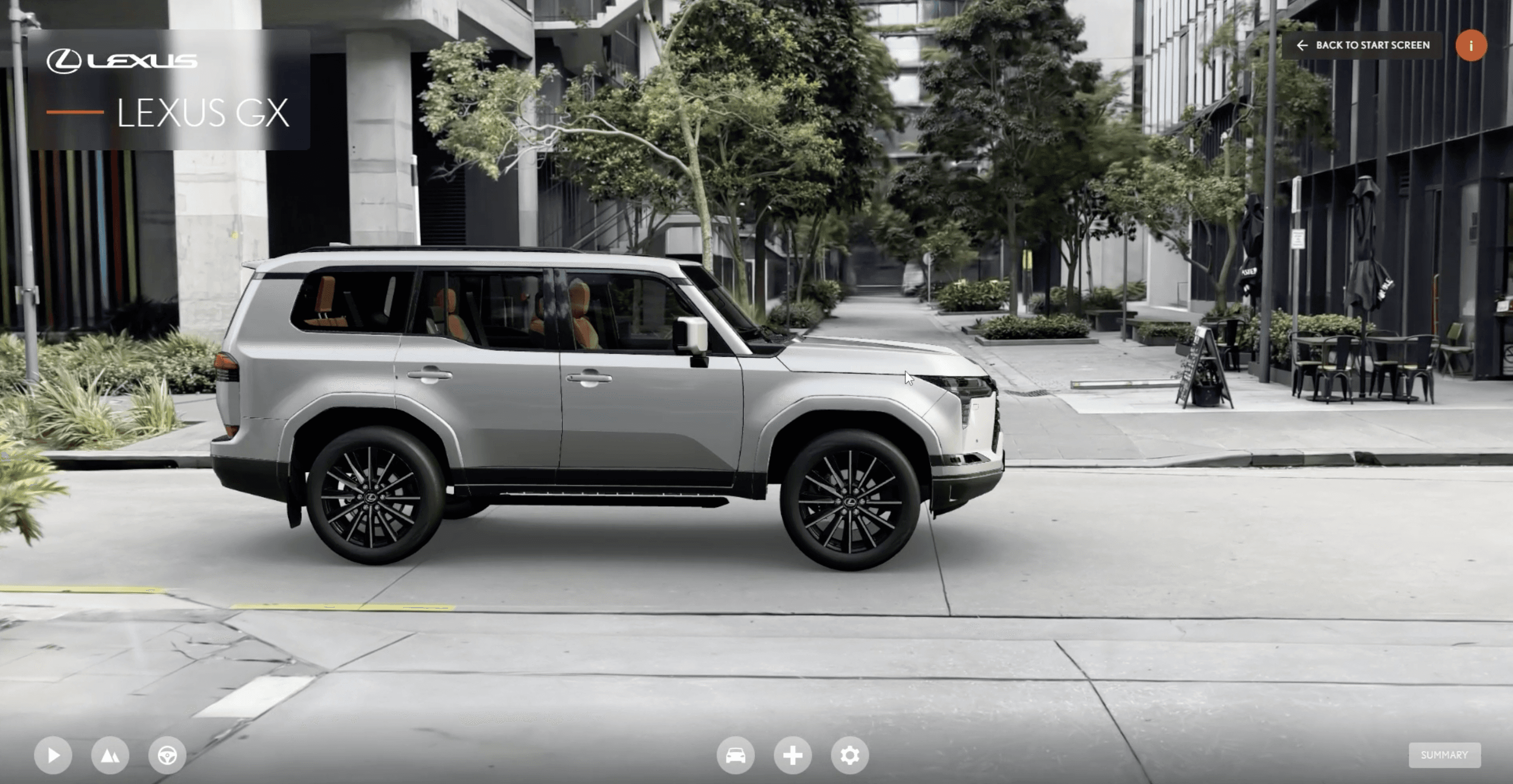
They found that the efficiency of radiance field capture and output was the real business driver. It’s essentially real time output, with minimal crew. You can compare that to a traditional commercial shoot, and it’s very compelling. Gaussian Splatting allows Rotor to deliver highly realistic automotive environments while reducing the complexity and cost of the shoot.
The faster capture enables them to stay agile with unreleased vehicles, which are often under strict confidentiality and logistical constraints.
The team continues to iterate on their capture pipeline, experimenting with camera arrays, capture patterns, and data scaling. A key bottleneck today is scaling the image count, where they’ve historically hovered around 4,000–5,000 input images but are now exploring how far they can push that number. “If we could take 20,000 images, we would,” joked the team. Much of this limitation is currently around hardware constraints and the need for better multi-GPU training pipelines. There have been traces of support coming out of NVIDIA with methods such as fVDB and geospatial giant Esri also showing massive reconstructions.
Rotor is also keeping a close eye on how standards like USD (Universal Scene Description) could eventually allow splats to slot directly into AR/VR devices like the Vision Pro. While they have their own internal proprietary formats today, they see long term value in pushing towards open standards if adoption grows. Moving Gaussian Splatting into well established formats, such as USD and GLTF would have rippling effects for bringing lifelike 3D into more professional workflows. Both The Khronos Group and the Open USD Alliance have made great headway on these fronts.
The importance of open and cross ecosystem standards is one of the crucial topics in the radiance field community. There will always be a place for custom, in house implementations that address specific use cases. However, if we want to avoid fragmentation and software silos, it’s essential to maintain several key open standards that enable pipeline modularity and professional, multi domain workflows. PLY as a container was a good beginning, but we clearly need more compression friendly and future proof formats.
On the rendering side, Rotor is still exploring various rendering options depending on the use case. They regularly use Postshot for its convenience, and sometimes Octane for more advanced path traced depth of field and motion blur when post rendered realism is critical. They’ve also experimented with custom Unreal Engine implementations to give them more control over radiance and foreground occlusion.
Rotor’s work perfectly illustrates the potential of real time game engines. Their architecture makes them powerful, modular rendering tools that enable high end visualization and product configuration, as seen in Rotor’s vehicle projects. The ability to combine high fidelity photorealistic assets, detailed simulations of atmospheric and lighting conditions, and Gaussian Splatting scans, all in a real time environment that can be output to various media, including animations, is a feature that makes software like Unreal one of the most suitable ecosystems currently available for working with Gaussian Splatting content. I have successfully leveraged it in my own Unreal-based projects.
Reflective car surfaces remain one of the primary challenges for splatting. While splatting excels at matte surfaces and interiors, the complex nature of highly reflective paint and glass creates artifacts that are still not fully solved. The team has seen strong results with matte finishes like orange or graphite but acknowledges that perfect reflections remain an open technical problem. This is where alternative radiance field representations, such as gaussian based ray traced or voxel approaches might present a solution.
Beyond capture and rendering, Rotor is also beginning to explore the role of generative AI in the pipeline. With tools like NVIDIA’s Cosmos and recently released GEN3C and Difix3D+, there are exciting possibilities and pathways to leveraging the models that are trained for Physical AI.
At Rotor Studios, gaussian splatting is proving to be a practical, scalable tool in production. One that delivers on the treasured convergence of speed, quality, and cost in a single pipeline. For VFX teams working in automotive or other high fidelity sectors, Rotor’s results are a clear signal that the future of digital capture and rendering may already be here.


