

World Labs Releases Marble Update

Michael Rubloff

Michael Rubloff

Email
Copy Link
Twitter
Linkedin
Reddit
Whatsapp
World Labs

World Labs has released a new update to Marble, continuing to refine the platform’s export workflow as Marble finds its way into more production oriented pipelines. The newest update focuses squarely on making generated worlds easier to move downstream, particularly for users exporting into DCC tools, engines, and simulation environments.

Marble exports are now roughly scaled and grounded by default, helping scenes better align with real world units when imported into external tools. This should reduce the amount of manual adjustment required after export, especially for workflows that depend on physical scale, such as robotics simulation or XR.

World Labs has also added an option to choose between OpenGL and OpenCV coordinate systems at export time. On the mesh side, users can now customize export preferences for higher quality geometry, choosing between vertex colored meshes and textured outputs depending on their downstream needs.

Alongside the export updates, World Labs has launched a new ask-ai channel on its Discord server. The channel is designed to provide fast, AI-powered assistance for Marble users, covering everything from troubleshooting and workflow questions to feature discovery.
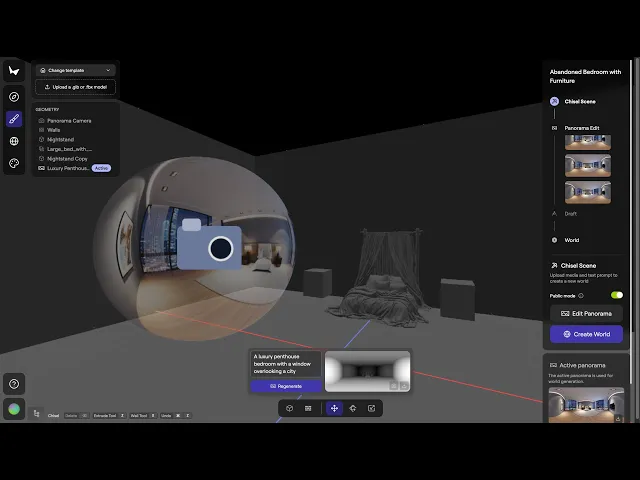
Finally, the company has published a new Chisel tutorial, offering a deeper look at Marble’s hybrid 3D editing workflow. The video walks through how to block out structure and customize environments using Chisel.

Learn more about World Labs on their website.

Featured

Recents

Platforms

three.js Ships Its Native Gaussian Splat Renderer and Splat Raycasting in r186

three.js r186 ships GaussianSplat, its first native Gaussian splat renderer, adding raycasting, per-mesh frustum culling and view-dependent spherical harmonics.

Michael Rubloff

Sep 9, 2026

Platforms

three.js Ships Its Native Gaussian Splat Renderer and Splat Raycasting in r186

three.js r186 ships GaussianSplat, its first native Gaussian splat renderer, adding raycasting, per-mesh frustum culling and view-dependent spherical harmonics.

Michael Rubloff

Platforms

PlayCanvas Releases SuperSplat 3.0

SuperSplat 3.0 rewrites PlayCanvas's Gaussian splat editor on WebGPU only, removing the WebGL2 path, cutting peak memory, and adding sort-free Stochastic Alpha.

Michael Rubloff

Sep 8, 2026

Platforms

PlayCanvas Releases SuperSplat 3.0

SuperSplat 3.0 rewrites PlayCanvas's Gaussian splat editor on WebGPU only, removing the WebGL2 path, cutting peak memory, and adding sort-free Stochastic Alpha.

Michael Rubloff

XGRIDS Adds WebXR Support to the LCC Web SDK in v0.6.3

XGRIDS LCC Web SDK v0.6.3 adds WebXR support to its Three.js and Cesium renderer, bringing browser-based headset viewing to LCC and LCC2 Gaussian splat scenes.

Michael Rubloff

Sep 8, 2026

XGRIDS Adds WebXR Support to the LCC Web SDK in v0.6.3

XGRIDS LCC Web SDK v0.6.3 adds WebXR support to its Three.js and Cesium renderer, bringing browser-based headset viewing to LCC and LCC2 Gaussian splat scenes.

Michael Rubloff

Splat Box Editor for Unity Now Ships Full Source Code

Simulacrum's $199 Splat Box Editor for Unity now includes full source code, with PLY and SPZ import and export, real-time relighting, shadow mapping and SSAO.

Michael Rubloff

Sep 4, 2026

Splat Box Editor for Unity Now Ships Full Source Code

Simulacrum's $199 Splat Box Editor for Unity now includes full source code, with PLY and SPZ import and export, real-time relighting, shadow mapping and SSAO.

Michael Rubloff

Trending Articles
  1. TRENDING
    Loading...
  2. TRENDING
    Loading...
  3. TRENDING
    Loading...
Michael Rubloff

Written by Michael Rubloff

Michael is the Founder and Managing Editor of Radiancefields.com

Email
Copy Link
Twitter
Linkedin
Reddit
Whatsapp

More from Michael Rubloff

More from Michael Rubloff

Platforms

three.js Ships Its Native Gaussian Splat Renderer and Splat Raycasting in r186

three.js r186 ships GaussianSplat, its first native Gaussian splat renderer, adding raycasting, per-mesh frustum culling and view-dependent spherical harmonics.

Michael Rubloff

Sep 9, 2026

three.js Gaussian Splatting

Platforms

three.js Ships Its Native Gaussian Splat Renderer and Splat Raycasting in r186

Michael Rubloff

Sep 9, 2026

three.js Gaussian Splatting

Platforms

three.js Ships Its Native Gaussian Splat Renderer and Splat Raycasting in r186

three.js r186 ships GaussianSplat, its first native Gaussian splat renderer, adding raycasting, per-mesh frustum culling and view-dependent spherical harmonics.

Michael Rubloff

Sep 9, 2026

three.js Gaussian Splatting

Platforms

PlayCanvas Releases SuperSplat 3.0

SuperSplat 3.0 rewrites PlayCanvas's Gaussian splat editor on WebGPU only, removing the WebGL2 path, cutting peak memory, and adding sort-free Stochastic Alpha.

Michael Rubloff

Sep 8, 2026

Supersplat 3.0

Platforms

PlayCanvas Releases SuperSplat 3.0

Michael Rubloff

Sep 8, 2026

Supersplat 3.0

Platforms

PlayCanvas Releases SuperSplat 3.0

SuperSplat 3.0 rewrites PlayCanvas's Gaussian splat editor on WebGPU only, removing the WebGL2 path, cutting peak memory, and adding sort-free Stochastic Alpha.

Michael Rubloff

Sep 8, 2026

Supersplat 3.0

XGRIDS Adds WebXR Support to the LCC Web SDK in v0.6.3

XGRIDS LCC Web SDK v0.6.3 adds WebXR support to its Three.js and Cesium renderer, bringing browser-based headset viewing to LCC and LCC2 Gaussian splat scenes.

Michael Rubloff

Sep 8, 2026

XGRIDS

XGRIDS Adds WebXR Support to the LCC Web SDK in v0.6.3

Michael Rubloff

Sep 8, 2026

XGRIDS

XGRIDS Adds WebXR Support to the LCC Web SDK in v0.6.3

XGRIDS LCC Web SDK v0.6.3 adds WebXR support to its Three.js and Cesium renderer, bringing browser-based headset viewing to LCC and LCC2 Gaussian splat scenes.

Michael Rubloff

Sep 8, 2026

XGRIDS