

DJI is continuing its steady push toward operationalizing radiance field representations, this time by bringing gaussian splatting into the orbit of its enterprise drone platform, DJI FlightHub 2. With its newest release, FlightHub 2 now supports workflows that incorporate Gaussian Splatting, adding onto the already existing support within DJI Terra.
FlightHub 2 has long been positioned as DJI’s command center for large scale drone deployments. It combines mission planning, fleet management, live remote operations, and cloud based data analysis into a browser based environment. The platform is widely used across public safety, infrastructure inspection, construction, and energy sectors, particularly in conjunction with autonomous docking systems and remote pilots operating fleets at scale. Until now, its 3D capabilities were largely framed around traditional photogrammetry outputs, meshes, point clouds, and orthomosaics, optimized for measurement and reporting rather than immersive inspection.
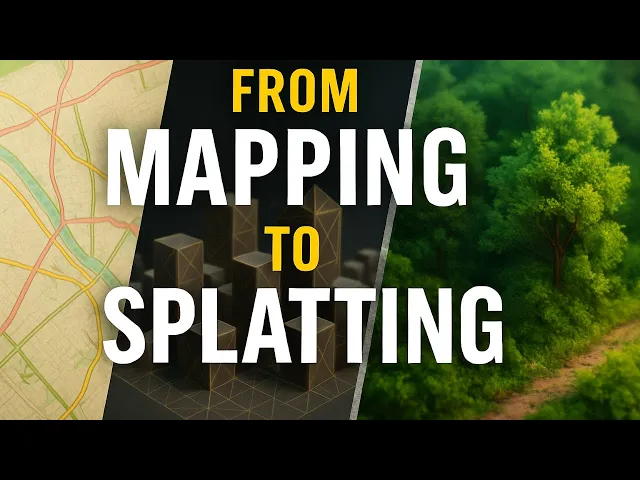
With gaussian splatting entering the picture, FlightHub 2 can ingest and work with a fundamentally different type of 3D representation. Instead of surfaces stitched into polygonal meshes, scenes are reconstructed as the radiance field method that preserve view dependent detail and complex visual phenomena like foliage, cables, reflective materials, and semi transparent structures.
Terra performs the heavy reconstruction work locally, turning aerial image sets into splats. Those outputs can then be uploaded into FlightHub 2, where they become part of the broader operational dataset, alongside timelines, measurements, annotations, and collaborative review tools.
FlightHub 2 integrates them directly into workflows that matter to enterprise users. Gaussian splats can be aligned with mission history, revisited over time, compared against newer captures, and contextualized within the same interfaces used for inspections, progress tracking, and incident response. In construction and infrastructure contexts, this opens the door to more faithful digital twins that preserve real world complexity instead of abstracting it away.
This also reflects a broader trend emerging across the radiance field ecosystem. Splats are moving into production systems. DJI’s inclusion of gaussian splatting inside a cloud operations platform used by governments and fortune scale enterprises underscores that transition. It suggests a growing confidence that radiance field representations are not only visually compelling, but reliable enough to inform decisions in environments where accuracy, repeatability, and traceability matter.
From a strategic standpoint, the update fits neatly into DJI’s push toward end to end autonomy. Drones capture data, reconstruction happens with minimal human intervention, and results flow directly into cloud based systems where teams can act on them immediately. Gaussian splatting strengthens that loop by reducing the friction between capture and comprehension. Instead of waiting on heavy mesh cleanup or tolerating brittle geometry, users can quickly explore scenes as they were actually seen by the drone.
High fidelity radiance field representations are becoming first class citizens in enterprise spatial workflows. DJI’s move makes it increasingly clear that the future of drone based reality capture is not merely about mapping the world, but about preserving it in three dimensions with as little loss as possible.
Learn more about FlightHub 2 here.


