

Niantic Spatial has launched Gaussian splat relighting in beta for selected design partners, using the aligned mesh that accompanies its reconstructions as the lighting proxy.
A Gaussian splat bakes the sun, atmosphere, shadows and weather into its captured appearance and carries no editable lighting model. A team that wants the same environment at dawn, under a different sky, or after a weather change has otherwise had to recapture and reconstruct the scene.
The Niantic Spatial workflow renders physically based sky lighting, sun and atmosphere, onto the aligned .glb mesh that ships with its reconstructions, uses precomputed radiance transfer to bake shadows and ambient occlusion, then transfers that lighting onto the individual Gaussians to produce relit variants. Geometry does not move. Niantic Spatial recomputes only the per Gaussian spherical harmonics appearance coefficients, so collision meshes, navigation meshes and semantic labels carry over untouched from one variant to the next.
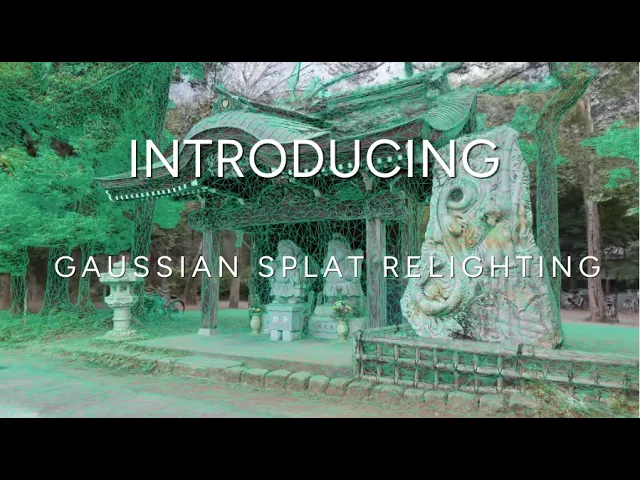
Precomputed radiance transfer has been in graphics research for decades, and the 2024 PRTGS paper applied it to Gaussian splats for soft shadows, indirect illumination and interreflections. The new step, in Niantic Spatial's framing, is applying that idea to its real to sim pipeline. Niantic Spatial and Spexi announced a partnership for city scale Gaussian splats earlier this year.
Variants generated so far cover sun and atmosphere changes, time of day including dawn lighting, fog and humidity driven dimming, rain and weather, and wet ground with reflective puddles. Generation is offline and in batches. The beta alters appearance and illumination only, with volumetric fog and animated rain treated as complementary simulation layers.
Relighting is only as good as the underlying mesh, and inaccurate geometry surfaces as visible artifacts in the relit splat. Natural scenes hold up best because irregular terrain and vegetation make small inaccuracies less perceptible, while flat surfaces, sharp corners, glass and windows are less forgiving and indoor scenes may require additional validation. Niantic Spatial publishes no timings, no scene counts and no partner numbers.
Each engagement runs as a loop of selecting a scene and target conditions, reviewing the source splat and mesh, producing an initial relit set, evaluating it inside the partner's own application or simulator, and feeding that back into the workflow and the renderer. Niantic Spatial calls it an early, collaborative capability and "not a self-service API." Access is by application only.


