
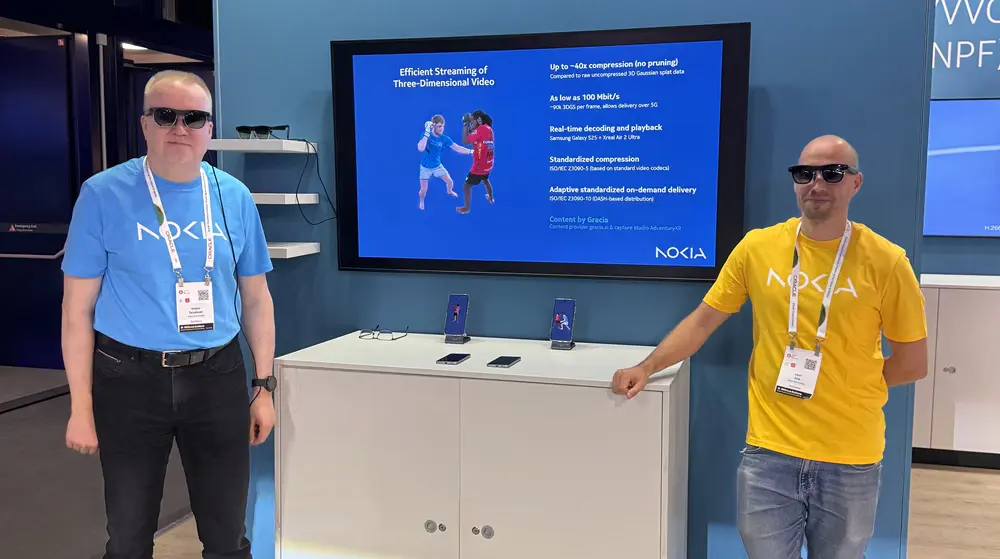
Nokia streamed dynamic gaussian splats over MPEG DASH at IBC 2026, rendering them in real time on Samsung mobile devices and XREAL glasses.
The splats are coded with MPEG Visual Volumetric Video-based Coding, V3C, and MPEG V-PCC Gaussian Splat Coding, known as GS4. Nokia stores the encoded sequences in MP4 and delivers them with DASH, the adaptive streaming protocol already used for conventional video. Nokia places GS4 under ISO/IEC 23090-5 and the DASH delivery of volumetric content under ISO/IEC 23090-10, both developed by ISO/IEC JTC 1/SC 29.
“Our aim is to make volumetric media as streamable and interoperable as video is today. Combining GS4 with DASH delivery lets photorealistic 3D experiences reach mainstream devices without fragmenting the ecosystem — turning a promising technology into something the industry can actually deploy” — Ville-Veikko Mattila, Head of Multimedia Research and Standardization, Nokia.
When MPEG asked for dynamic gaussian splat test material in August ahead of a call for proposals on splat coding, Nokia's Patrice Rondao Alface was one of the two named contacts. Test material for that call is due October 15, 2026.
It is both exciting and important that these initiatives continue. Having the foundations firmly placed for volumetric lifelike media such as gaussian splatting will be critical to the advancement of imaging to move into 3D. Over a time period that the general public would be surprised by, it is likely that several industries who primarily communicate visual content in 2D will find that gaussian splatting and other radiance field representations are a fundamentally more powerful and valuable form of media.
Nokia's full write-up is available here.