
When we last spoke to Evercoast, the music video for A$AP Rocky’s Helicopter had just released. Seven months later, a new music video project they worked on just released, and it quickly racked up 10 million views within a week.
I spoke to Evercoast’s CEO, Ben Nunez about the project and how it was made.
Helicopter was a 56-camera RGB-D rig producing roughly 30 minutes of final splat footage. What did the .exe rig look like by comparison, and what's actually different in the pipeline now?
.exe was shot with only 21 cameras and produced 3.5 minutes of final splat footage from 12.5 minutes of raw camera footage.
The array configuration was largely the same as Helicopter: a full 360-degree ring of cameras facing inward. It was also captured on an RGB-D array, operated by a client, Tricomtek, that has an Evercoast system installed in its studio in Korea.
It is pretty incredible what can be achieved with relatively low resolution, fairly sparse camera arrays using Evercoast's software. Evercoast supports super high resolution, high density arrays as well, but the RGB-D array cost is much lower and when the aesthetic of the video does not call for extremely high-resolution data, there is no reason to take on the added cost and complexity.
Helicopter's post ran through Houdini/GSOPs/Octane. Same stack here, or did the Korean side bring their own?
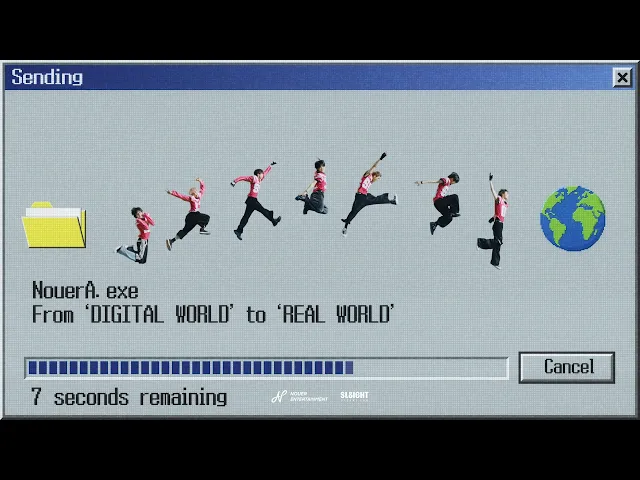
This was a different stack. The .exe video used Evercoast's Unreal Engine plugin, including its relighting capabilities. The studio who produced the video (SL8 Studio) is interested in experimenting with the Houdini, GSOPs and Octane workflow, but given the schedule and budget, our Unreal Engine plugin was the right approach for this production.
Six months on: is anything from that project now productized versus bespoke?
The Helicopter workflow already fit within Evercoast's commercial product stack, so it wasn't a bespoke pipeline that needed to be converted into a product afterward. The .exe production used the same exact Evercoast capture and reconstruction products. The studio could activate its system, begin capturing, review live reconstructions and postvisualization renders immediately, then submit their selects through Evercoast's cloud pipeline for final quality output.
Evercoast continues to improve the capture, reconstruction, rendering and playback stack, but the fundamental workflow used on both projects was already productized.
Where was this shot? Did the group come to New York, did Evercoast ship a system to Seoul, or did a Korean studio run it as licensees?
It was shot in Seoul, Korea using an Evercoast system already installed at Tricomtek's studio. The artists did not travel to New York and Evercoast did not ship a system for the production. Tricomtek operates the platform locally, which allowed the production to be completed without Evercoast personnel needing to be on set (though we'd have loved to go!).
Seven members. Were they captured individually and composited, or in the volume together?
They were captured individually and combined in post. One of the practical constraints of a 21-camera, lower-resolution system is the usable capture volume. For Helicopter, we expanded the volume to accommodate more people simultaneously by using more cameras. At the other end of the spectrum, our higher-resolution 4K and 6K systems and higher-camera-count configurations can support substantially larger capture areas. We recently completed a Hollywood production using a 90-camera 4K system operating at 48 and 60 frames per second within a 10-meter-diameter volume. Totally different scale and output quality. Our platform can be scaled to match the number of performers, required image quality and physical dimensions of the production.
Comeback schedules are fixed and immovable. What was the turnaround from capture to delivered assets?
Evercoast provides real-time reconstruction on set, along with preview renders that can be generated within seconds (also on set). Selected captures can then be uploaded to the cloud platform, where a final-quality render can typically be reviewed in approximately an hour.
That gives production teams immediate visibility into what was captured and greater confidence in the downstream result. Once the production had chosen its selects, the processed assets were delivered within hours.
Who initiated: the label, the director, or Evercoast?
Tricomtek is Evercoast's client and SL8 Studio produced the video. Evercoast was relatively hands-off during the production. An existing client on the other side of the world activated its installed system, captured the performances and produced the final material using our platform.
That is an important part of the story for us: the technology doesn't require Evercoast to send a specialized team to every production in order to achieve a finished result. Production teams around the world can use our software to do this same kind of work.
What in the final video is actually splat versus conventional VFX?
If you have to ask…! :) The splat footage appears throughout the video, particularly in the dance sequences featuring extreme camera movement and the performers placed within unusual environments, perspectives and spatial arrangements.
The surrounding environments, compositing and additional effects combine conventional VFX techniques with the captured 4D performances. The splats provide the actual volumetric representations of the artists, allowing the camera to move freely around them in ways that would be difficult or impossible with conventional footage.
Two major music videos in seven months. Is 4DGS becoming a standard tool for music video and entertainment?
It is becoming a more established tool across a wide range of virtual production projects in entertainment. Volumetric gaussian splatting allows filmmakers to create camera movement and spatial compositions that would otherwise be extremely difficult, impossible or prohibitively expensive using conventional video production and VFX.
It also preserves the appearance and performance of a real person in a way that traditional computer generated characters often cannot. Generative AI is expanding the range of visual possibilities, but precise control and temporal consistency remain difficult. Though we are increasingly seeing the two approaches combined, with captured splat data providing an authentic, controllable human performance and generative systems extending or transforming the captured asset and environment around it.
While 3D gaussian splatting was the first bridge to industry adoption of radiance field representations, 4D gaussian splatting will be the first radiance field representation to emotionally resonate with consumers. Learn more about Evercoast here.