
RealityScan 2.2 delivers what Epic calls one of the most requested features in the application’s history. Full AMD GPU support. For a tool that has sat at the front of so many gaussian splatting and NeRF pipelines as the Structure from Motion stage, the change rapidly expands the potential user base. Every stage is equally accelerated on Radeon and Radeon PRO, with Epic stating it is the same pipeline at the same speed.
RealityScan can now mix AMD and NVIDIA cards in the same machine, splitting the workload across every supported GPU in parallel. A rig with a GeForce and a Radeon installed side by side will put both to work on the same job. Support spans the modern AMD desktop and workstation lineup, from RDNA 4 gaming cards through RDNA 3 PRO workstation GPUs. AMD support is Windows only at launch, with Linux noted as coming later.
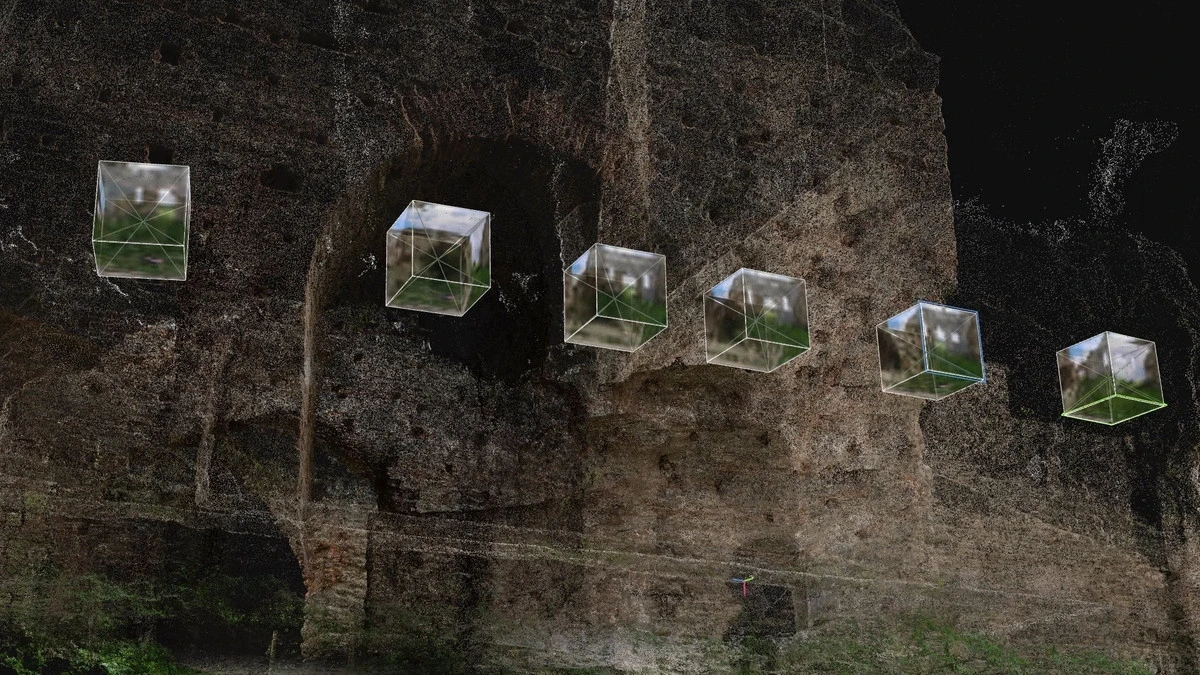
The release also formalizes a 360 camera workflow through a new tutorial and a small companion web app. The appeal of 360 capture for reconstruction obvious, since a single shot covers an entire scene. Epic’s PanoToViews web app, hosted on its public GitHub, converts equirectangular stills into cube-face views and writes XMP sidecars carrying the calibration metadata RealityScan needs. Because equirectangulars are undistorted by nature and the app can calculate focal length, RealityScan can skip lens correction during alignment, which both speeds up processing and makes 360 hardware a reader may already own into a viable input.
The tool defaults to a 90-degree field of view per cube face, and can be widened up to 120 degrees to introduce overlap between faces and give sparse views, such as a wall against empty sky, more to align against.
The rest of 2.2 is the usual stability pass. On the import side, two separate “end of physical tape” errors during COLMAP ingestion were fixed, one tied to the 3D Maker Pro Eagle SLAM scanner and one caused by a trailing space in the input. Alignment received several fixes covering a hang that never completed on specific datasets, a crash with locked camera positions, incorrectly produced single-camera components, and bad camera rotation in browser-viewable sparse reconstruction reports. The CLI saw corrections to the -addImageWithCalibration and -importLaserScanFolder commands, alongside editor and texturing fixes.
This continues a steady year of iteration on the platform, following version 2.1.1’s COLMAP interchange work, the automation and remote-execution push in 2.1, and the 2.0 milestone that first arrived at UnrealFest with alignment, AI masking, and LiDAR ingestion improvements. RealityScan remains free for individuals and companies under Epic’s revenue threshold.


