Autodesk Makes 3D Gaussian Splats an Editable Native Object Type in 3ds Max 2027.2

Michael Rubloff


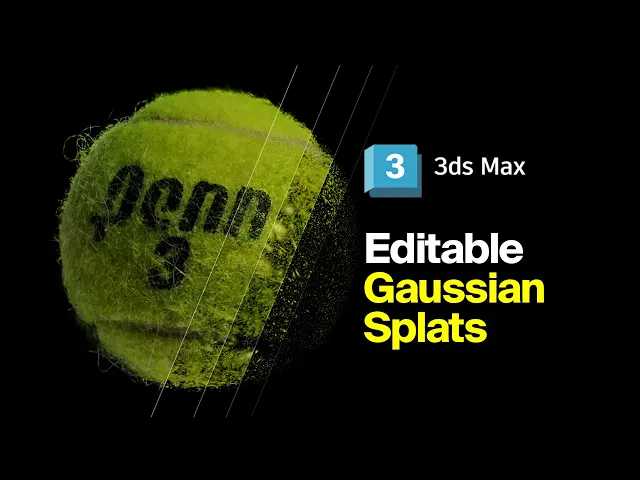
Autodesk has released 3ds Max 2027.2, which makes 3D Gaussian splats an editable, native object type. The format is now backed by a new Points object whose every point carries position, orientation, scale, color, custom attributes, and instanced geometry, so a captured scene can be deformed, selected, converted, instanced, and rendered inside the same modifier stack as meshes and splines. Announced at SIGGRAPH 2026, the update also ships Arnold for 3ds Max (MAXtoA) 5.9.3.0, which renders the new native 3DGS data directly.
Bringing 3DGS into a 3ds Max pipeline was already possible on the render side. Arnold 7.5.2 added 3DGS rendering and relighting via a new gaussian_splat_shader detailed the MAXtoA 5.9.3 route, where a capture could sit in a rendered shot, cast shadows, appear in reflections, respect opacity in shadows, and respond to scene lights. But in that model the splat remained a fixed, file referenced asset. 2027.2 makes it into a 3ds Max object that lives in the stack.
A splat imported in PLY, SPZ, or LCC and previewed in an ActiveShade window becomes editable through two paths. Standard deformation modifiers, bend, twist, squash, operate non-destructively on the underlying point data, so the same tools artists already use on geometry now push captured data around without baking it. For finer control, a gaussian splat can be converted into an Editable Point object that exposes its stored attributes directly. Point positions, orientation, splat size, color, opacity, and spherical harmonic data, can all be moved, rotated, scaled, duplicated, or driven with Soft Selection and preserved in named selection sets. A new Point Select modifier lets an artist isolate or hide part of the point cloud and apply modifiers farther up the stack to that selection alone.
The point tooling is also not limited to splats. 2027.2 introduces a broader Points object type, and polygon objects and splines can be turned into point data, either directly or through a new Turn to Point modifier, generated from existing vertices, a target surface count, surface density, or object volumes, with controls for placement, jitter, normals, and color. Modifiers can then target all points, a selection, Soft Selection regions, named sets, or points that share an attribute value, giving a procedural route from conventional geometry into point-based representations. Sitting on top of that is the new Point Instance modifier, which places referenced scene objects, geometry, lights, groups, or Gaussian Splats, onto point data as true render-time instances, with distribution, probability, and position/rotation/scale variation controlled from the modifier.
Instances can themselves contain instances, and Autodesk states the system can represent hundreds, thousands, or millions of objects from a single source mesh and an organized point dataset. For AI-assisted work, environments generated in World Labs Marble can be imported straight into 3ds Max and refined as ordinary scene data rather than round-tripped through an external tool.
On the render side, Arnold for Max 5.9.3.0 works with the native 3DGS data and the new Points object, so lighting, shading, and color can be dialed in for the final image. The same MAXtoA build adds an improved denoiser, faster GPU scene updates, and the new Shader to RGBA and tone zones nodes for non-photorealistic rendering, and it can drive the Point Instance modifier to render those instanced datasets.


New to Gaussian Splatting? Start here