
Framestore Details Its Superman 4D Splatting Pipeline

Framestore's Superman talk details its 4D Gaussian splatting pipeline, from a 192-camera, 88-second take trained in Postshot to per-shot PLY files in Houdini.

Framestore's Superman talk details its 4D Gaussian splatting pipeline, from a 192-camera, 88-second take trained in Postshot to per-shot PLY files in Houdini.

Michael Rubloff

Michael Rubloff

Michael is the Founder and Managing Editor of Radiancefields.com

Superman splats

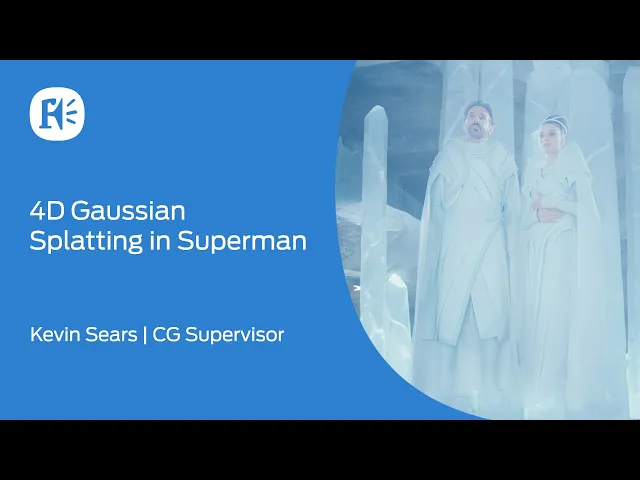
Framestore has published a 54-minute breakdown of the 4D Gaussian splatting pipeline behind the Kryptonian holograms in Superman.

Kevin Sears, a CG supervisor at Framestore Montreal, delivered the talk as a webinar on September 22, and Framestore posted it to YouTube on October 21. The holographic messages from Superman's Kryptonian parents were splat performances reshaped in Houdini, and the look ended up in about 30 shots. The shoot took place in August 2024 in Ipswich after Framestore persuaded the client not to move the setup to Los Angeles, with James Gunn supervising remotely.

Infinite Realities captured the performance on 192 cameras recording 12 megapixel images at 24 fps, and each frame resolved to about 1.6 million splats. The capture volume is roughly the size of a small bedroom, and Sears said it was the first time Infinite Realities had put two performers that close together in it. The client chose a single take of about 88 seconds, which was cut up to cover every shot. That works out to about 2,000 frames per camera and a little over 400,000 images.

Infinite Realities trained the sequence in Postshot on 20 processing nodes with RTX 4090 GPUs, and the final splat took several days after a few rounds of rising quality. Early results chattered around faces, hair and the white costumes, and a longer retrain of several more hours per frame cleaned them up. The source images were 8 bit and the data came to about 5 TB per take. Infinite Realities delivered a PLY sequence with the actors cropped in 3D and the ground plane removed.
At the time, Postshot could not load animated cameras, Houdini did not load splats natively, Nuke had no splat plugin and there was no relighting. ShotGrid fields from editorial drove a Houdini setup that wrote a unique PLY sequence per shot, while layout placed an unanimated proxy model at scales from about 10 feet to about 6 inches. The splats could not be moved inside the renderer, so assistant technical directors built a constraint system that baked one camera per splat cluster, so a shot with three or four clusters had three or four render cameras.

Rendering ran through Inria's SIBR Viewer, with opacity and alpha controls added by Infinite Realities and rotations and time offsets added later. Sears rendered every splat himself through a command line batch, pushing alpha above the solved value so the front of a face never revealed the back of the head, and output 4K PNG frames. The FX team ran a newer Houdini than the pipeline supported, used CG Nomads' GSOPs to write splats out natively, and explored particles shedding from the edges before abandoning them.

A native Nuke splat plugin arrived late in the project and was tested, but the final shots did not use splats inside Nuke. Compositing applied the edge opacity treatment in 2D with little use of depth channels, along with heavy grading and denoising. Every frame was trained independently with no temporal coherence, so temporal denoising in comp reduced the chatter along the edges. Asked about a fallback, Sears said there was not really one beyond projecting the 192 camera feeds onto cards, which was never needed.

Sears said Houdini and Nuke now load splats natively and that he would not necessarily reuse this workflow today. According to Sears, Framestore has used splats for environment work on commercials, but he has not seen the studio use them to replace animated characters. The full talk is available on Framestore's YouTube channel.

Thumbnail for Gaussian Splatting News episode 12

11:38

Watch · New every Monday

Splats Come to Fortnite, Nike Shoots in 4D, Splats on a Nintendo 3DS

Episode 12 · Nov 9, 2026

Epic’s UEFN 43.00 brings Gaussian splats into the Unreal Editor for Fortnite, importing PLY and SPZ files that render on every platform UEFN supports, mobile included.

Featured

Recents

Platforms

Spirula Studio v2026.11.12 Adds Calibration Correction

Spirula Studio v2026.11.12 corrects rolling shutter and other camera calibration residuals during training and adds an experimental GLOMAP-style SfM mapper.

Michael Rubloff

Nov 12, 2026

Platforms

Spirula Studio v2026.11.12 Adds Calibration Correction

Spirula Studio v2026.11.12 corrects rolling shutter and other camera calibration residuals during training and adds an experimental GLOMAP-style SfM mapper.

Michael Rubloff

Platforms

Unreal Engine 5.9 Preview Adds Experimental Gaussian Splats

Unreal Engine 5.9 MegaJam Preview lists experimental Gaussian splat import on its roadmap, bringing PLY and SPZ splats into the world with Niagara integration.

Michael Rubloff

Nov 11, 2026

Platforms

Unreal Engine 5.9 Preview Adds Experimental Gaussian Splats

Unreal Engine 5.9 MegaJam Preview lists experimental Gaussian splat import on its roadmap, bringing PLY and SPZ splats into the world with Niagara integration.

Michael Rubloff

Guest Article

Training Gaussian Splats From Renders, Not Photos

Most 3DGS pipelines start with a camera and end with a scene you look at. Mine starts with a mesh and ends with a boss you shoot apart. Here is what changes.

zakons

Nov 11, 2026

Guest Article

Training Gaussian Splats From Renders, Not Photos

Most 3DGS pipelines start with a camera and end with a scene you look at. Mine starts with a mesh and ends with a boss you shoot apart. Here is what changes.

zakons

Platforms

SpAItial Opens Its Echo-3 API to Every Developer Account

SpAItial's Echo-3 API is now open to every developer account, turning a ZIP of phone frames into a metric-scale Gaussian splat for 900 credits plus 1 per frame.

Michael Rubloff

Nov 11, 2026

Platforms

SpAItial Opens Its Echo-3 API to Every Developer Account

SpAItial's Echo-3 API is now open to every developer account, turning a ZIP of phone frames into a metric-scale Gaussian splat for 900 credits plus 1 per frame.

Michael Rubloff

Trending Articles
  1. TRENDING
    Loading...
  2. TRENDING
    Loading...
  3. TRENDING
    Loading...
Michael Rubloff

Written by Michael Rubloff

Michael is the Founder and Managing Editor of Radiancefields.com

More from Michael Rubloff

More from Michael Rubloff

Platforms

Spirula Studio v2026.11.12 Adds Calibration Correction

Spirula Studio v2026.11.12 corrects rolling shutter and other camera calibration residuals during training and adds an experimental GLOMAP-style SfM mapper.

Michael Rubloff

Nov 12, 2026

Spirula Studio

Platforms

Spirula Studio v2026.11.12 Adds Calibration Correction

Michael Rubloff

Nov 12, 2026

Spirula Studio

Platforms

Spirula Studio v2026.11.12 Adds Calibration Correction

Spirula Studio v2026.11.12 corrects rolling shutter and other camera calibration residuals during training and adds an experimental GLOMAP-style SfM mapper.

Michael Rubloff

Nov 12, 2026

Spirula Studio

Platforms

Unreal Engine 5.9 Preview Adds Experimental Gaussian Splats

Unreal Engine 5.9 MegaJam Preview lists experimental Gaussian splat import on its roadmap, bringing PLY and SPZ splats into the world with Niagara integration.

Michael Rubloff

Nov 11, 2026

Unreal Engine 5.9

Platforms

Unreal Engine 5.9 Preview Adds Experimental Gaussian Splats

Michael Rubloff

Nov 11, 2026

Unreal Engine 5.9

Platforms

Unreal Engine 5.9 Preview Adds Experimental Gaussian Splats

Unreal Engine 5.9 MegaJam Preview lists experimental Gaussian splat import on its roadmap, bringing PLY and SPZ splats into the world with Niagara integration.

Michael Rubloff

Nov 11, 2026

Unreal Engine 5.9

Platforms

SpAItial Opens Its Echo-3 API to Every Developer Account

SpAItial's Echo-3 API is now open to every developer account, turning a ZIP of phone frames into a metric-scale Gaussian splat for 900 credits plus 1 per frame.

Michael Rubloff

Nov 11, 2026

Echo-3

Platforms

SpAItial Opens Its Echo-3 API to Every Developer Account

Michael Rubloff

Nov 11, 2026

Echo-3

Platforms

SpAItial Opens Its Echo-3 API to Every Developer Account

SpAItial's Echo-3 API is now open to every developer account, turning a ZIP of phone frames into a metric-scale Gaussian splat for 900 credits plus 1 per frame.

Michael Rubloff

Nov 11, 2026

Echo-3

New to Gaussian Splatting? Start here

Radiance fields, explained from the ground up: what a Gaussian splat is, how to capture one, and which tools and gear to start with.

Newsletter

Keep up with the field.

New research, tools and captures from the Radiance Fields newsroom, in your inbox. Free, no spam.

Gaussian Splatting News on YouTube

The week in radiance fields, every Monday.

Gaussian Splatting News on YouTube

The week in radiance fields, every Monday.

Gaussian Splatting News on YouTube

The week in radiance fields, every Monday.

Gaussian Splatting News on YouTube

The week in radiance fields, every Monday.